

A not-so-rare yet rarely diagnosed cause of fatigue.
When the autonomic nervous system raises its hand.

A note for longtime readers: If you subscribed to The Multiple Sclerosis Insider, welcome — this is the same publication, with a new name and a wider lens. The Neuroimmunologist now covers not only MS but the other conditions I see and study in clinic: NMOSD, MOGAD, autoimmune encephalitis, POTS, hypermobile Ehlers-Danlos syndrome, and small fiber neuropathy. The MS content you signed up for continues, and if you'd prefer to receive only that, Substack lets you subscribe to a single section. But you may find there is much to learn at the intersection of different neuroimmune conditions. Today’s post is the perfect example. Enjoy!
“Doctor, I am tired.”
She says it the way you report a fact you’ve stopped expecting anyone to act on. Flat. A little apologetic, even, as though the exhaustion is a personal failing she’s come to confess. Forty-two years old. She has three kids and a fatigue so complete that some mornings the shower undoes her. She steps out, sits on the edge of the bed, and has to lie back down before she can dress. Dinner gets made in stages, with a horizontal pause between chopping and cooking. The school pickup line is a feat of planning.
“I can’t take care of them,” she told me. “I can’t take care of anything.”
She has multiple sclerosis, diagnosed a few years ago, well controlled on high-efficacy therapy. Her scans have been quiet and her last relapse is far behind her. Though this is my first time meeting her, her previous neurologist having just retired, I know that by every measure I usually reach for, her MS is behaving. And yet here she is, describing a life narrowed to the distance between one horizontal surface and the next.
It would have been easy and it would have been wrong to write this down as MS fatigue, nod sympathetically, and move on. Fatigue is the most common symptom in MS and one of the most disabling. It is also, too often, where the conversation stops. The label is so available, so expected, that it can absorb everything that walks through the door looking tired, and become an excuse for not doing anything.
So I slow down and ask her to walk me through a bad day.
The detail that changes everything
It wasn’t activity that wiped her out, exactly. It was being upright. Standing at the stove. Standing in line. Standing in the shower. She felt more human lying down and emptied out the moment she got vertical. Heat made it dramatically worse. A hot summer afternoon had her retreat to her air-conditioned bedroom. Every so often, in those upright moments, her heart would race and she’d feel oddly short of breath, as if she’d jogged up a flight of stairs, while standing perfectly still. She didn’t bring up this last fact on her own, ashamed that I would dismiss her as being deconditionned, but I have learned to ask these questions.
That pattern is not the signature of classic MS fatigue. MS fatigue tends to deepen as the day wears on and doesn’t particularly care what position you’re in. Heat worsens it too, so heat alone doesn’t tell us much. But the posture dependence, the racing heart, the breathlessness on standing: that’s the autonomic nervous system raising its hand.
I asked her to do a simple test at home: lie quietly for at least 10 minutes then check her heart rate while lying down. Next, stand up slowly and try to continue standing for 10 minutes, checking her heart rate at 1, 3, 5, and 10 min after standing. She sent me the numbers. Lying down: 70 beats per min (bpm). Standing: 145 bpm.
A jump of seventy-five beats, with no drop in blood pressure to explain it.
That is postural orthostatic tachycardia syndrome or POTS, and it had been masquerading as her “MS fatigue” the entire time and gone unaddressed.
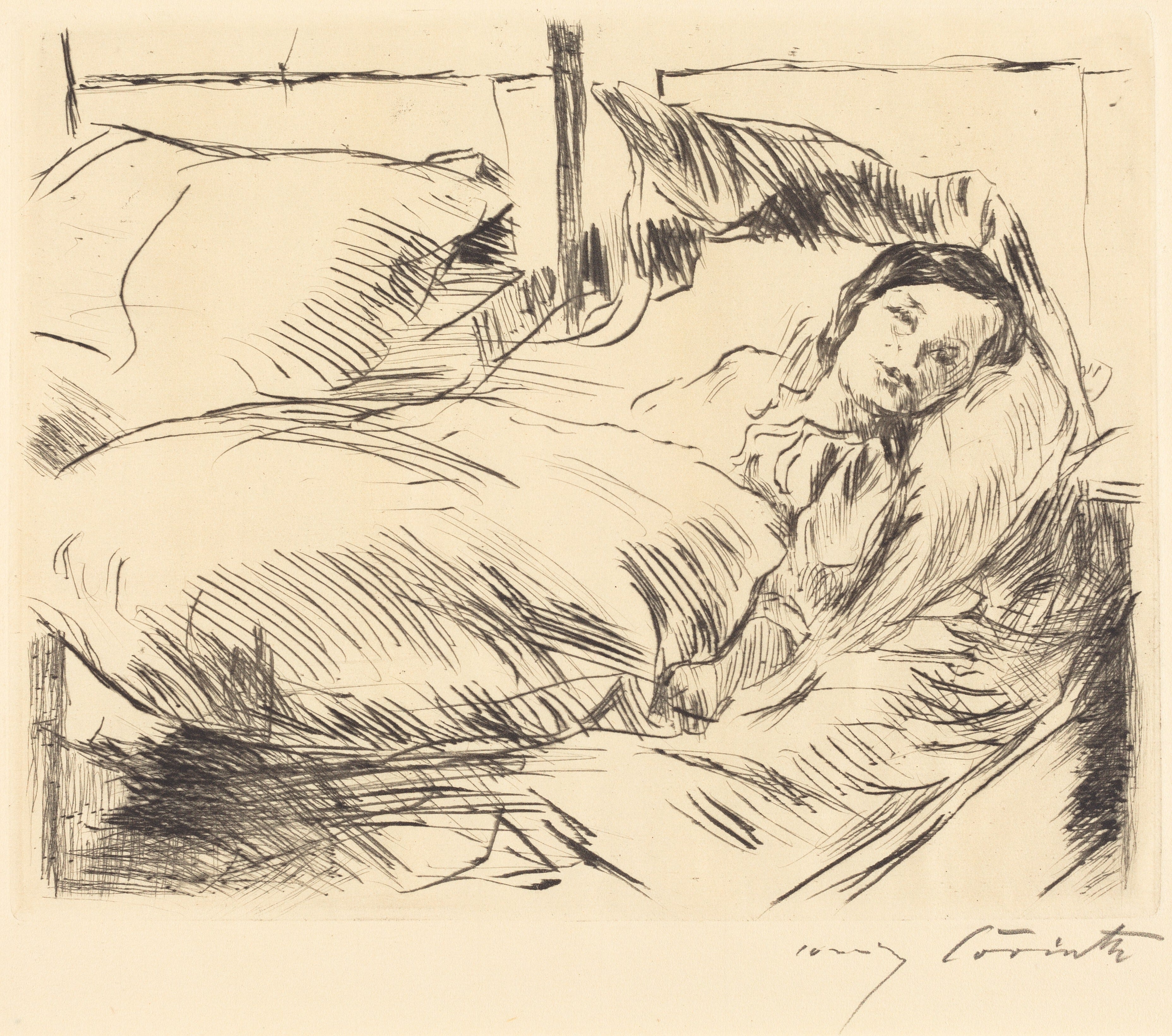
Das Kranke Kind by Lovis Corinth, 1918. Courtesy National Gallery of Art, Washington.
Why this hides in plain sight in MS
Here is the part that should change the questions we ask. POTS and broader autonomic dysfunction are not rare bystanders in MS. They’re common, and we miss them constantly. And chances are, you’ve never heard of them.
So first, a quick word on what we’re actually talking about. Your autonomic nervous system is the part of your nervous system that runs the background tasks you never think about: heart rate, blood pressure, digestion, body temperature, the automatic adjustments that keep you steady when you stand up. When that system misfires, we call it dysautonomia. POTS is one specific kind of dysautonomia where standing triggers an excessive heart rate increase without a significant blood pressure drop. This is most often caused by the body failing to tighten the blood vessels properly, with blood pooling in the legs, and the heart compensating by racing. POTS isn’t a heart problem or a fitness problem. It’s a signaling problem.
In a large comparative study using the gold standard tilt-table testing, POTS showed up in about 19% of people living MS, compared with roughly 10% of people without MS who had orthostatic symptoms. Cast the net wider, beyond strict POTS to any measurable autonomic abnormality and the numbers climb startlingly: up to 84% of MS patients show some autonomic dysfunction, with orthostatic intolerance (intolerance to being upright) affecting around half.
It also tracks with how active the disease is. In one study, POTS turned up in 32% of patients during a relapse versus under 7% in remission. Over a six-year follow-up, the share of MS patients with symptomatic dysautonomia nearly doubled, and relapses raised the odds of developing it almost fourfold. The autonomic nervous system, it turns out, is paying close attention to what the immune system is doing.
So why does it get missed? Because MS and POTS hand you the same opening complaint: *I’m exhausted.* From my experience in the clinic, people don’t walk in saying “I have orthostatic intolerance.” They tell me they are tired. If we accept the most familiar explanation that MS is just making you tired without asking the next question, the treatable cause stays hidden in plain sight.
How to tell if you have POTS
The good news is that the detecting POTS is mostly free. It takes a good history and in a set of vital signs you can get at the bedside.
POTS-related fatigue is positional, worse on standing, better lying down. It’s frequently worst in the morning, when the orthostatic heart rate surge is more pronounced, and it often travels with company: palpitations, lightheadedness, presyncope, breathlessness on standing. Confusingly, it can also show up as a flat, non-positional tiredness in nearly half of patients, which is exactly why the bedside test matters.
The practical move is almost embarrassingly simple: check heart rate and blood pressure lying down, then standing, at one, three, five, and ten minutes. A rise of at least 30 beats per minute on standing — 40 in adolescents — without a drop in blood pressure points toward POTS. When suspicion stays high despite normal bedside numbers, a formal tilt-table test settles it. The COMPASS-31 questionnaire is a validated way to screen for the broader autonomic symptom burden, and it correlates strongly with how fatigued patients actually feel.
None of this requires advanced equipment. It requires curiosity.
What’s actually going wrong
When I explain POTS to my patients, I try to resist the urge to make it sound like one tidy thing, because it isn’t. In MS especially, the autonomic trouble tends to come from several directions at once.
Some of it is central. MS lesions can land in the brain’s autonomic control circuitry — the insula, cingulate, hypothalamus, brainstem — the network that controls involuntary body functions, coordinates responses to stress, and maintains internal balance. Damage or dysregulation of the central autonomic network can scramble the signal.
Some of it is peripheral. MS is increasingly recognized as affecting the small nerve fibers outside the brain and cord, and small-fiber neuropathy is a well-known driver of the most common POTS subtype, where the blood vessels in the legs fail to clamp down on standing and blood pools, forcing the heart to race to compensate. Small fiber neuropathy can be confirmed with a simple skin punch biopsy, and in my clinic, I have diagnosed many of my MS patients with small fiber neuropathy. In my experience, these individuals tend to have worse pain and fatigue than those without detectable small fiber neuropathy.
And some of it appears to be autoimmune in a more direct sense. A growing body of work has found that many people with POTS harbor antibodies against the body's own adrenergic and muscarinic receptors, the very receptors that regulate the cardiovascular response to standing. In laboratory studies, these antibodies can impair the ability of blood vessels to constrict and can directly activate cardiac receptors, offering a plausible molecular explanation for the racing heart. The findings are intriguing but not yet definitive: the autoantibody associations have not been consistently replicated across cohorts, and leading experts caution that no causative antibody has been convincingly established. Still, the pattern fits a broader theme: POTS frequently co-occurs with other autoimmune conditions, often follows an immune trigger like infection, and in some patients may respond to immunomodulatory treatment.
There’s even a feedback loop worth discussing here, because it captures something essential about how I think about all of this. The autonomic nervous system isn’t just a passive victim of MS, it helps regulate the immune system. When it falters, the body’s built-in brake on inflammation can loosen, which may, in turn, feed more disease activity. Brain, immune system, autonomic nerves are not three separate stories, but one.
Why it matters: this is treatable
Here is the reason I won’t let “it’s just MS fatigue” stand unchallenged. POTS opens a door that classic MS fatigue often doesn’t.
The first-line treatments aren’t even prescriptions. Increasing fluid and salt intake, and wearing compression garments can meaningfully reduce the orthostatic surge. Exercise can also be very effective for POTS, but it has to be done the right way, starting with activities done entirely on the floor or in a reclined position like swimming or recumbent biking rather than upright workouts, and building up slowly over weeks. It's important to tell the difference between normal tiredness after exercise and a crash that leaves you feeling worse for days, which is a sign the plan needs adjusting, not pushing through. For people with MS, this balance matters even more, because MS brings its own fatigue and heat sensitivity into the mix.
When medication is warranted, options like ivabradine or low-dose beta-blockers can blunt the racing heart, though beta-blockers need a careful hand in MS because they can deepen fatigue. Midodrine helps some patients who also have low blood pressure but calls for caution in anyone with MS-related bladder dysfunction. In a small series of MS patients whose POTS was finally recognized and treated, two-thirds were able to return to their daily activities.
Two-thirds. After months or years of being told they were simply tired.
There’s a longer-game point, too. Controlling MS aggressively and early may itself protect the autonomic nervous system. Escalating to high-efficacy disease-modifying therapy was associated with a markedly lower risk of objective autonomic dysfunction down the line. Treating the disease well isn’t separate from treating the autonomic nervous system. It may be part of it.
Back to the clinic
I don’t want to wrap this in a bow. POTS in MS is genuinely complex and the evidence is still maturing. Fatigue remains poorly understood and not every fatigued patient has a hidden orthostatic problem waiting to be found. And more importantly, while treatable, POTS is not always reversible.
But stories like this one are precisely why I keep returning to the same conviction: the most powerful diagnostic tool I have is the next question. My patient didn’t need a new scan or an exotic test. She needed someone to notice that her exhaustion had a specific pattern and to take that pattern seriously.
She came in to confess her fatigue like it was a failing. She left with a diagnosis, a plan, and the beginning of her life back.
If you’re living with MS and your fatigue is worse on your feet, eases when you lie down, and sometimes comes with a pounding or racing heart: that’s worth saying out loud at your next visit, in exactly those words. It’s not a complaint. It’s a clue.
In your corner,
Dr. Freeman
Want to know if you may have POTS?
I wrote an article in the Skills and Practices section of this publication on how to test at home. It comes with a printable tip sheet.
You can follow the link here.
References
Adamec I, Lovrić M, Žaper D, Barušić AK, Bach I, Junaković A, Mišmaš A, Habek M. Postural orthostatic tachycardia syndrome associated with multiple sclerosis. Auton Neurosci. 2013 Jan;173(1-2):65-8. doi: 10.1016/j.autneu.2012.11.009. Epub 2012 Dec 14. PMID: 23246200.
Winder K, Linker RA, Seifert F, Wang R, Lee DH, Engelhorn T, Dörfler A, Fröhlich K, Hilz M. Cerebral lesion correlates of sympathetic cardiovascular activation in multiple sclerosis. Hum Brain Mapp. 2019 Dec 1;40(17):5083-5093. doi: 10.1002/hbm.24759. Epub 2019 Aug 12. PMID: 31403742; PMCID: PMC6865522.
Foschi M, Giannini G, Merli E, Mancinelli L, Zenesini C, Viti B, Guaraldi P, Cortelli P, Lugaresi A. Frequency and characteristics of dysautonomic symptoms in multiple sclerosis: a cross-sectional double-center study with the validated Italian version of the Composite Autonomic Symptom Score-31. Neurol Sci. 2021 Apr;42(4):1395-1403. doi: 10.1007/s10072-020-04620-1. Epub 2020 Aug 10. PMID: 32776288; PMCID: PMC7955976.
Adamec I, Bach I, Barušić AK, Mišmaš A, Habek M. Assessment of prevalence and pathological response to orthostatic provocation in patients with multiple sclerosis. J Neurol Sci. 2013 Jan 15;324(1-2):80-3. doi: 10.1016/j.jns.2012.10.006. Epub 2012 Nov 3. PMID: 23127354.
Ruška B, Adamec I, Crnosija L, Gabelić T, Barun B, Junakovic A, Krbot Skoric M, Habek M. Evolution of autonomic nervous system abnormalities in multiple sclerosis: a 6-year follow-up. J Neurol Neurosurg Psychiatry. 2025 Oct 15;96(11):1093-1098. doi: 10.1136/jnnp-2024-335376. PMID: 40274400.
Guido G, Valsasina P, Morozumi T, Preziosa P, Romanò F, Rocca MA, Filippi M. Functional Connectivity Alterations of the Central Autonomic Network in Multiple Sclerosis: Links to Fatigue and Aerobic Training Effects. Neurol Neuroimmunol Neuroinflamm. 2026 Jul;13(4):e200585. doi: 10.1212/NXI.0000000000200585. Epub 2026 May 11. PMID: 42118052; PMCID: PMC13174567.
COMPASS-31 [https://www.hattrevaluationtools.eu/compass-31/]
Great read. Diagnosis is an unusual path that’s for sure. I also have low b12 which requires injections. All three illnesses (b12, pots, ms) have very different signs of how my fatigue symptoms show up. So strange!