

"No Evidence of Disease Activity" Is the Floor, Not the Ceiling.
3 reasons why some people with MS aren't getting there and what to do about it

“My MS is stable. My neurologist says I’m doing great.”
She’d come for a second opinion mostly to humor her sister. She felt fine. No relapses in years. She walked into my office with no cane and no obvious problem.
Then we pulled up her MRIs.
Three new lesions over two years. None of them had caused a symptom she could feel. Her previous neurologist had noted them in his reports and changed nothing.
She wasn’t stable. She was accumulating damage quietly, the way MS so often does.
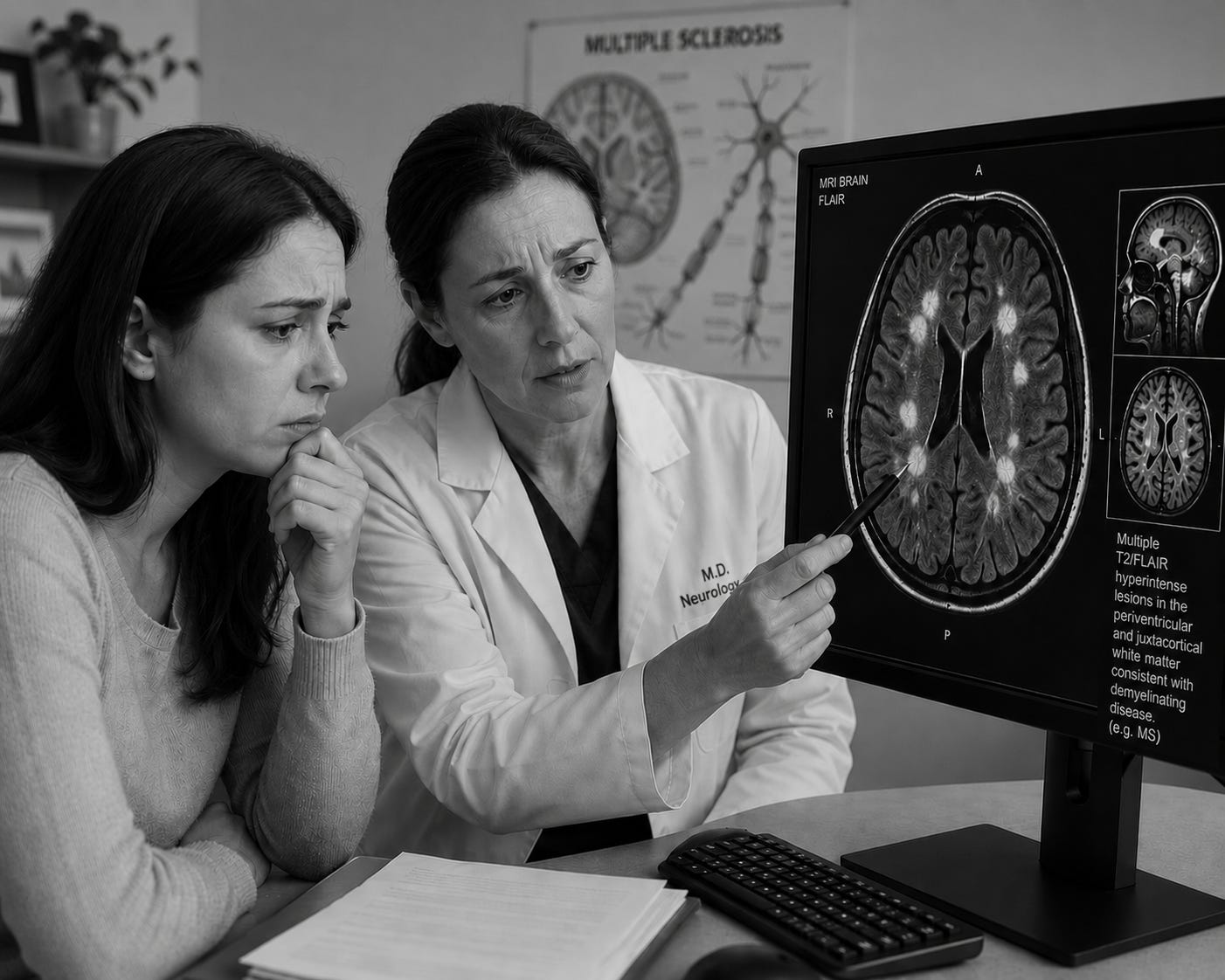
In MS care, we have a phrase for what we should be aiming for: “No evidence of disease activity”. Disease activity in MS means evidence that your immune system is attacking the brain or spinal cord right now. Not damage from years ago, but new injury happening on the current timeline.
It generally shows up as:
A relapse: new symptoms (blurred vision, numbness, weakness, imbalance) that come on over hours to days and last more than 24 hours. This is disease activity you can feel.
A new lesion on MRI: a fresh spot of inflammation in the brain or spinal cord, with or without active gadolinium enhancement. This is disease activity whether or not you feel it. Most new lesions never produce a symptom a patient would notice: they happen in regions with redundancy, or they’re small enough to be quietly absorbed. But they aren’t harmless.
For a long time, no evidence of active disease was the aspirational goal. I think about it differently now. NEDA is the floor, not the ceiling. It’s the outcome we should expect (not just hope for) when someone is on the right treatment, monitored properly, and with the right diagnosis.
When patients aren’t getting there, it almost always comes down to one of three things.
You are on the wrong drug.
MS therapies fall, broadly, into three camps: platform, moderate-efficacy and high-efficacy. Platform therapies, which we don’t call low-efficacy to not hurt their feelings, are the good ol’ injectable drugs, the interferons and glatiramer acetate. Moderate-efficacy therapies are primarily our oral agents: teriflunomide, the fumarate class (e.g. dimethyl fumarate) and the S1P modulators (e.g. fingolimod). High-efficacy treatments are our immunotherapies (B-cell therapies, natalizumab, alemtuzumab) as well as cladribine.
The evidence has been clear for years now. Starting with high-efficacy treatment, especially early in disease, leads to fewer relapses, less disability accumulation, and better long-term outcomes than the older approach of starting low and escalating only after damage has been done. The brain doesn’t get those years back. If you need to see the evidence for yourself, start with this article I co-authored: High-Efficacy Therapies for Treatment-Naïve Individuals with Relapsing–Remitting Multiple Sclerosis
And yet many people are still on therapies that aren’t controlling their disease. Sometimes the conversation about high-efficacy options never happened. Sometimes it’s a “let’s wait and see” stance that quietly stretches into years. Sometimes the initial choice was perfectly reasonable but isn’t working anymore and no one has cared to look or ask the next question.
There’s another scenario worth naming: when even the right high-efficacy drug, used early, isn’t fully controlling the disease. Situations like these are called “highly active” disease, or refractory and they represent another area where I think there is a quiet gap. Clinical trials are an option that often gets overlooked yet has the potential to provide access to mechanisms we don’t yet have on the shelf. Hematopoietic stem cell transplants, CAR-T therapies, and other agents are currently being tested in refractory disease. Some of these will pan out and some won’t. That’s the nature of trials. But enrolling typically means careful monitoring, no cost for the study drug, and a real shot at something the approved menu can’t yet offer. A lot of highly specialized trials run out of academic MS centers. If your community neurologist isn’t tracking what’s open, asking for a one-time consultation referral is a reasonable thing to do.
You have the wrong neurologist.
I want to say this carefully, because most of my colleagues are excellent. But MS care has a quiet problem called therapeutic inertia. This is the tendency to leave things alone even when the data say it’s time to change course.
It looks like this: a new lesion appears on MRI. The neurologist notes it but doesn’t act. A year later, another one, dismissed. The patient feels fine, so change doesn’t seem urgent. But MS is rarely urgent in the moment. It’s urgent over a decade.
A proactive MS neurologist does a few things consistently:
- Orders MRIs on a regular schedule, typically annually, and more often after a treatment switch, using a standardized protocol that allows real comparison year over year.
- Reads the MRI themselves, not just the radiology report. Subtle activity gets missed otherwise.
- Considers serum biomarkers like neurofilament light chain (NfL), or multianalyte panels, which can pick up damage even when the scan looks quiet, or confirm a subtle change.
- Treats stability as the standard, not a stroke of luck. When new activity appears, they lean in and have a conversation about why and what to change.
If your visits are mostly “see you in a year, keep doing what you’re doing,” or “if it’s not broken why fix it” without a careful review of your history and imaging, it may be worth asking more questions. Or asking them somewhere else.
You have the wrong diagnosis.
This is the one I most want you to know about, because it’s the most invisible.
MS is a clinical and radiologic diagnosis. There’s no single test that confirms it. And there are conditions that can look strikingly like MS on a scan or in a clinic note but aren’t MS, and don’t respond to MS drugs.
The list is longer than people realize. NMOSD (neuromyelitis optica spectrum disorder) and MOGAD (MOG antibody-associated disease) are the most important to rule out. They require different treatment, and some MS therapies can actually make them worse. Small vessel ischemic disease, B12 deficiency, Susac syndrome, CADASIL, sarcoidosis, and certain infections can all produce white matter lesions that mimic MS.
When someone is on the right drug, monitored properly, and still worsening, the question isn’t always “what’s the next drug?” Sometimes it’s “are we treating the right disease?”
Going back to basics with a careful re-review of the original MRI, the spinal fluid, the antibody testing, the clinical story has changed the diagnosis for more patients than I can count. Sometimes that conversation is hard. Often it’s the opening to a treatment that finally works.
And what’s above the floor?
If no evidence of disease activity is the floor, what’s the ceiling?
It’s a moving target, and it’s where MS care is heading. Preserving brain volume. Preventing the slow, smoldering progression that happens independent of relapses (what we call PIRA, progression independent of relapse activity). Protecting cognition, mood, sleep, fatigue.
From a pharmacologic standpoint, we are not all the way there yet. We’re getting closer. But we need not forget what we can address without the prescription pad. Comorbidities such as high blood pressure, elevated cholesterol, diabetes, obesity accelerate disability in ways no MS drug can fully offset. Smoking is a strong, independent driver of progression, and worth stopping at any stage of disease. Adequate vitamin D, regular aerobic exercise, treating sleep apnea and depression, protecting sleep itself. These aren’t lifestyle extras. They’re disease-modifying in their own right, and they compound with whatever drug you’re on.
What I’d want you to take with you
If you have MS, NEDA is a reasonable outcome to expect. Not a miracle. A baseline.
Getting there usually means three things working together: a treatment matched to your disease rather than to inertia; a neurologist who watches closely and responds when something changes; and, when the picture doesn’t add up, the willingness to ask whether the diagnosis itself still fits.
You’re allowed to ask your neurologist what your last MRI showed compared to the one before.
You’re allowed to ask whether a higher-efficacy option might be appropriate.
You’re allowed to ask whether NMOSD and MOGAD antibodies have ever been checked.
You’re allowed to ask whether serum biomarker testing would be useful.
You are about to ask what you can do to protect your brain health and prevent disability progression.
You are allowed to ask if there is a clinical trial you would benefit from.
And when you ask, you deserve an answer. Not a flippant one. One rooted in evidence.
Good MS care isn’t passive. It shouldn’t feel like waiting. And it certainly shouldn’t feel like you are not being heard.
This is a great article. Nobody knows what I have at this point. One doctor says this and another says that... I'm in the middle.. the only certain is.. more MRIs.. I will not have the spinal tap due to my clotting disorder..