

Reading the FDA’s Warning Carefully: Tolebrutinib and the Cost of Uncertainty
A balanced review of the FDA's safety concerns regarding tolebrutinib.

This felt worse than receiving a lump of coal. On Christmas Eve 2025, the FDA issued an unexpected Complete Response Letter for the new drug application for tolebrutinib, stating that it could not approve the medication for use in non-relapsing secondary progressive MS. To say that the MS community was stunned by this decision would be an understatement.
Caring for people living with progressive MS has become one of the most challenging aspects of modern MS care. The disease can be relentless, and once progression begins, our options to meaningfully alter its course remain painfully limited. Against that backdrop, this decision landed heavily for clinicians, researchers, and, most importantly, for people living with progressive disease.
The FDA’s Complete Response Letter is publicly available here:
https://download.open.fda.gov/crl/CRL_NDA219624_20251223.pdf
I believe it is important for us, as a community, to carefully dissect and reflect on what this letter actually says. It is a complex document that approaches the problem from multiple angles (safety, effectiveness, target population, and trial design) and it is not always straightforward. Reasonable experts may read this letter and come away with different interpretations. That, in itself, is not a failure; it is part of the process of grappling with difficult and consequential decisions.
In a previous piece, I wrote that the art and science of modern MS care lies in pairing innovation with vigilance, optimism with responsibility. I reflected on past examples in MS where serious complications only became fully apparent after FDA approval. There is no doubt in my mind that safety must come first. MS is a marathon, not a sprint. Without an acceptable safety profile, no medication, no matter how promising, can have a meaningful or lasting impact on the millions of people living with this disease.
With that in mind, I propose that we look objectively at what we know from the trial data and from the FDA’s letter about the safety concerns associated with tolebrutinib. We will examine not only how concerning these signals are in isolation, but also how they compare with liver safety profiles of other BTK inhibitors already approved in different conditions, and how they fit within the broader historical context of drug development and regulatory caution in MS.
In a future piece, I will explore more deeply what this letter signals for the future of clinical trial design and drug development in progressive MS. The FDA’s concerns raise fundamental questions about how we define progression, how precisely we select and describe patient populations, and whether our current clinical descriptors truly capture the biology we aim to treat. They also challenge us to examine whether traditional endpoints and subgroup analyses are sufficient for regulatory decision-making in this space. Ultimately, how we respond to these signals may shape which therapies ever make it to patients.
Safety concerns at the forefront
“The Division has determined that the data are insufficient to support a claim of slowing disability accumulation independent of relapse activity, particularly in the context of the significant risk of DILI, because of the reliance on post hoc analyses; the uncertainties regarding the concept of disability accumulation independent of relapse activity; the limitations of the mechanistic rationale; and the negative results of Study EFC16035 [PERSEUS trial of tolebrutinib in PPMS] on cCDP.”
— FDA Complete Response Letter to Sanofi
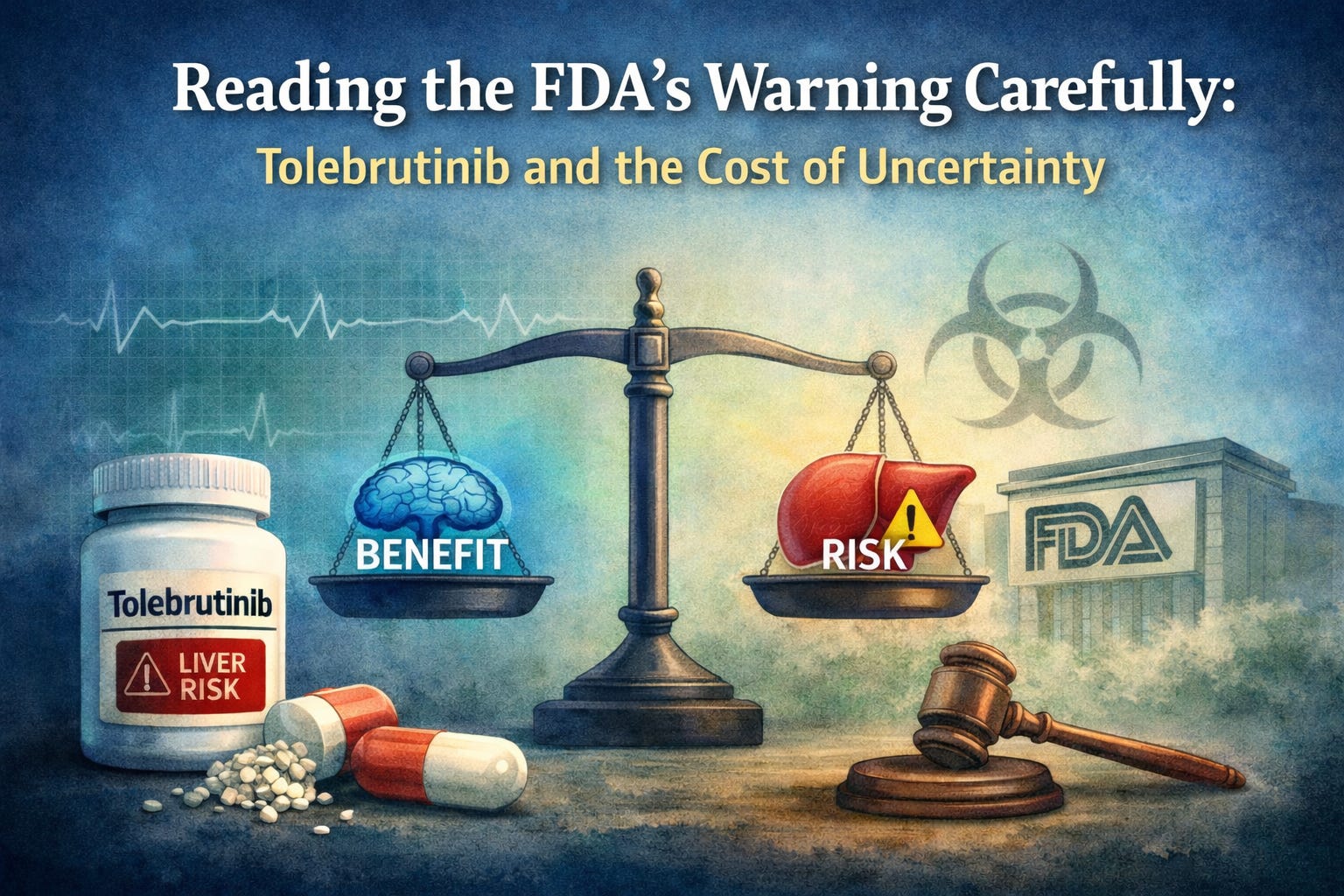
At its core, the FDA’s decision comes down to benefit–risk balance. While tolebrutinib showed signals of efficacy in some analyses, meeting its primary endpoint in non-relapsing secondary progressive MS and demonstrating secondary effects on confirmed disability worsening in relapsing MS trials, what ultimately tipped the scale was safety. The FDA identified a concerning rate of severe drug-induced liver injury (DILI), including a fatal case. The agency made it clear that even meaningful efficacy signals cannot offset a safety risk of this magnitude unless the benefit is both unequivocal and uniquely necessary. In this case, the FDA concluded that the observed benefits were neither sufficiently robust nor clearly attributable to the intended population of people with non-relapsing secondary progressive MS.
What are DILI and Hy’s Law?
DILI, or drug-induced liver injury, refers to liver damage caused by a medication rather than by viral hepatitis, alcohol, or other medical conditions. Clinically, DILI spans a wide spectrum from asymptomatic laboratory abnormalities, such as mild ALT or AST elevations that resolve on their own, to severe hepatitis, liver failure, transplantation, and death. The challenge is that the most dangerous forms of DILI are often unpredictable, not clearly dose-dependent, and not reliably prevented simply by “being careful.”
When the FDA refers to Hy’s Law cases, it is not invoking a technicality, it is raising a warning flare. A Hy’s Law case describes a specific and concerning pattern: hepatocellular injury (markedly elevated ALT or AST) accompanied by jaundice (elevated bilirubin), without an alternative explanation. Historically, the presence of Hy’s Law cases during development has been associated with a meaningful risk of severe liver injury once a drug is used more broadly.
This matters because clinical trial populations are not the real world. Trial participants are carefully selected: they tend to be younger, have fewer comorbidities, and agree to frequent visits and laboratory monitoring. Once a drug enters routine clinical practice, those guardrails disappear. Patients may have unrecognized underlying conditions, competing medications, or inconsistent access to laboratory testing. Even the most attentive clinician cannot fully control those variables. This is why the FDA places such weight on a Hy’s Law signal: it remains one of the strongest pre-market predictors of rare but life-threatening hepatotoxicity.
How concerning was the DILI signal with tolebrutinib?
In its Complete Response Letter, the FDA described the risk of severe DILI with tolebrutinib as “substantial and unusually high,” not only within the context of MS, but across drug development more broadly. The agency reported six cases meeting Hy’s Law criteria among approximately 2,700 Phase 3 participants, including one patient who required a liver transplant and later died.
This is the key point. The concern was not that liver enzymes were occasionally elevated. It was the presence of rare, severe, and potentially fatal liver injury: the kind of risk that fundamentally alters the benefit–risk calculus in a chronic disease where treatment may continue for years.
Why might liver injury occur frequently with tolebrutinib?
One possible contributor to the liver safety signal observed with tolebrutinib relates to drug selectivity, or how precisely a medication engages its intended biological target. More selective agents are designed to act narrowly on BTK, whereas less selective compounds may interact with additional proteins or signaling pathways beyond their primary target. In the liver, where drug metabolism and immune regulation are tightly intertwined, such off-target interactions may disrupt normal hepatic balance in some individuals. Rather than producing predictable, dose-related toxicity, this can manifest as rare liver injury that is difficult to anticipate or prevent.
How does this compare to other FDA-approved BTK inhibitors?
BTK inhibitors are not new to the FDA. Several are already approved in hematologic and oncologic indications—a very different clinical context—and their labels make it clear that liver enzyme elevations do occur. However, the pattern seen with these agents generally resembles laboratory abnormalities rather than a clustered signal of Hy’s Law cases, liver transplant, or death.
Currently, four BTK inhibitors are FDA-approved for hematologic or oncologic use (ibrutinib, acalabrutinib, zanubrutinib, and pirtobrutinib), and one, remibrutinib, is approved for chronic spontaneous urticaria. Notably, remibrutinib is also being studied in MS.
Among these agents, the hepatic safety profile appears most favorable for remibrutinib. In its pivotal trials, no potential Hy’s Law cases were identified, and rates of transaminase elevations were very low. This may relate to its highly selective BTK inhibition and its binding to an inactive BTK conformation, which may limit off-target effects.
Acalabrutinib shows more variable rates of transaminase elevations depending on trial design and whether it is used in combination therapy. In the ECHO trial (mantle cell lymphoma treated with bendamustine and rituximab), AST increased in 53% and ALT in 44% of patients, with Grade 3–4 elevations in 5% and 7%, respectively. In monotherapy trials, however, rates were notably lower, with ALT elevations around 15–20% and AST elevations around 13–17%.
Zanubrutinib generally demonstrates low rates of transaminase elevations in clinical trials, most commonly Grade 1–2. However, a single documented Hy’s Law case after approximately 30 months of treatment serves as an important reminder that severe DILI can occur, even if rarely, long after treatment inception. In that case, a hepatocellular injury pattern was observed, with complete resolution after drug discontinuation.
Pirtobrutinib has also shown relatively low rates of Grade 3–4 transaminase elevations (approximately 1.6–2.8%), broadly comparable to other more selective BTK inhibitors.
Ibrutinib, by contrast, has documented post-marketing cases of hepatic failure, including acute and fatal events, though specific Hy’s Law cases have not been well described in the literature. In clinical trials, AST elevations occurred in approximately 25% of patients, with Grade 3–4 elevations in about 3%.
This comparison requires nuance. These data are not directly comparable to MS trials: they involve different diseases, different baseline risks (including hepatic involvement and polypharmacy), different trial designs, and different standards for laboratory reporting.
Still, the directional signal matters. Liver enzyme elevations are common across the BTK inhibitor class, but the FDA’s concern with tolebrutinib centers on a pattern consistent with severe, clinically consequential DILI, including multiple Hy’s Law cases and a transplant-associated death. That combination, not isolated lab abnormalities, is what causes regulators to pause and reassess.
Why a REMS may not be enough for severe DILI
What is a REMS program?
A REMS, or Risk Evaluation and Mitigation Strategy, is a safety program required by the FDA when a medication carries serious known or potential risks that cannot be adequately managed through standard labeling alone. The goal of a REMS is straightforward in theory: to reduce the likelihood or severity of serious harm while still allowing patients access to a medication that may offer meaningful benefit.
In practice, a REMS can include one or more of the following components:
Special patient education (such as medication guides or consent forms explaining risks)
Provider certification or training requirements
Mandatory laboratory monitoring
Pharmacy restrictions (limiting dispensing to certain pharmacies)
“No test, no drug” rules, in which medication cannot be dispensed without up-to-date safety labs
Idiosyncratic DILI is fundamentally hard to risk-manage
The most concerning forms of DILI are idiosyncratic, meaning they are not predictable based on dose, duration, or obvious clinical risk factors, and they are not reliably prevented by avoiding certain comorbidities. While we do not have full public details of the REMS program Sanofi proposed for tolebrutinib, it appears to have included frequent liver monitoring, with weekly labs likely for a defined period after treatment initiation rather than indefinitely.
For many drugs, liver tests function as a smoke detector, not a fire extinguisher. Monitoring ALT, AST, and bilirubin can sometimes identify early injury and prompt drug discontinuation. But the FDA’s concern here is that tolebrutinib may cause rare, severe, and occasionally rapidly progressive liver injury, events in which stopping the drug may come too late for some patients. When the potential outcome is liver failure, transplant, or death, “we’ll monitor closely” may not be an adequate mitigation strategy.
A REMS assumes near-perfect real-world execution and real life is never perfect
REMS programs work best under ideal conditions: labs are easy to obtain, results return quickly, clinicians consistently review them, patients can reliably comply, and systems enforce “no lab, no drug” rules.
In real-world practice, however, friction is unavoidable. Missed lab appointments, delayed results, holiday gaps, insurance changes, travel, alert fatigue in electronic health records, and unclear lines of responsibility between neurology, primary care, and pharmacy all introduce vulnerability. If the residual risk after imperfect adherence remains high, the FDA may reasonably conclude that a REMS cannot render the benefit–risk balance acceptable.
Risk tolerance in MS is different than in oncology and a REMS doesn’t change that
In oncology, patients and regulators may accept higher toxicity because the alternative is often limited survival. MS is fundamentally different. Treatment is typically long-term, and many patients will live for decades with the disease. In that context, even very rare catastrophic adverse events become difficult to justify, particularly when the benefit signal is modest or uncertain and potential exposure could be widespread.
A REMS can reduce some risk, but it cannot erase the ethical and clinical weight of rare, irreversible harm in a chronic disease.
Haven’t we gone through this already in MS?
No, this is not Tysabri
It is natural to look for historical parallels in moments like this, but the comparison to Tysabri (natalizumab) ultimately falls short in my opinion. Tysabri entered the MS landscape as the first truly high-efficacy therapy at a time when many patients had exhausted the available injectable options. Its clinical benefit was large, immediate, and unmistakable, transforming outcomes for thousands of people who had failed platform therapies. Crucially, its most devastating risk, progressive multifocal leukoencephalopathy (PML), was not observed during clinical trials and only emerged after post-marketing use.
In real-world data, the estimated risk of PML during the first two years of treatment ranged from approximately 0.01 to 1 per 1,000 patients per year. Importantly, this risk was not entirely idiosyncratic. Early on, risk factors such as prior use of immunosuppressive therapy were identified, and the later introduction of anti-JCV antibody testing allowed clinicians to individualize treatment decisions and meaningfully stratify risk. That context changed everything for patients and prescribers. Even then, it is also fair to wonder whether Tysabri would have been reintroduced after the initial PML cases had it been 2020 rather than 2006, when multiple safer high-efficacy options already existed.
Tolebrutinib presents a fundamentally different scenario. Here, serious safety signals, specifically severe drug-induced liver injury, were already visible during clinical development. Unlike PML with Tysabri, these events occurred before approval, not after. If such a drug were used broadly, it is reasonable to anticipate that clinically significant liver injury would occur at a higher frequency than PML ever did with natalizumab. At the same time, the magnitude of benefit appears more modest: a reported 31% delay in time to confirmed disability progression is unlikely to have the same life-transforming impact that Tysabri offered many patients in the mid-2000s. Taken together, this is not a story of extraordinary benefit tempered by rare, late-emerging risk, but one of moderate benefit—or in the FDA’s own words, uncertain benefit, though I will debate this in my next piece— confronting early and serious safety warnings.
Why this feels closer to Zinbryta
In many ways, the FDA’s response to tolebrutinib feels closer to the lesson of Zinbryta than to Tysabri. Zinbryta (daclizumab) was approved by the FDA in 2016 for relapsing forms of MS and withdrawn worldwide in 2018, less than two years later, not because it lacked efficacy, but because of serious, unpredictable immune-mediated toxicity. These toxicities included severe autoimmune hepatitis, fulminant liver failure, immune-mediated encephalitis and meningoencephalitis, and fatal outcomes, sometimes in patients who had previously appeared stable on therapy.
Importantly, meaningful safety signals were already present during Zinbryta’s clinical development. Immune-mediated liver injury and broader signs of immune dysregulation were observed in trials. A review by Giovannoni and colleagues of three clinical studies of daclizumab (SELECT, DECIDE, and OBSERVE) identified three Hy’s Law cases with probable causality among 2,236 trial participants, a signal that, in retrospect, should have carried more weight. For context, the FDA reports six Hy’s Law cases among approximately 2,700 participants in the tolebrutinib program.
Rather than prompting a fundamental pause, the Zinbryta safety signal was managed through increasingly intensive monitoring requirements and a REMS that ultimately proved insufficient once the drug entered real-world use. The tragedy of Zinbryta was not that it failed to work, although by the time it was withdrawn, its efficacy had been surpassed by B-cell therapies, but that early warnings were rationalized away, and catastrophic outcomes continued despite safeguards.
Seen through that lens, the FDA’s decision on tolebrutinib reads less like regulatory paternalism and more like institutional memory: a clear unwillingness to approve a therapy when serious, unpredictable harm is already visible before approval and cannot be convincingly mitigated by monitoring alone.
None of this diminishes the urgency we all feel when caring for people living with progressive MS, or the disappointment that follows when a promising therapy stumbles. Safety is only one side of the equation but it is the side that must be addressed first. In the next piece, I will turn deliberately to the other half of this story: what the tolebrutinib data and the FDA letter do and do not tell us about clinical benefit, and what this means for the future of drug development in MS. Because thoughtful progress in this space will require holding both truths at once: the need to protect patients from harm, and the equally pressing need to move the field forward.
Very helpful perspective! Looking forward to your next piece on clinical benefits and trial design. Thank you.
Well……. It’s the risk reward thing that one of the group members talked about in one of my men’s group meetings. As he said, he was 72 or so, and if the drug had a 10% chance of killing him, but a 50/50 shot at stopping all progression with maybe some improvement? He would probably take it, or at least consider it. My wife and I would have to have a long talk, but I would at least consider it. When the author says it is different than Tysabri, she is talking about the timing of when they discovered the PML fatalities; tolobrutinib showed the risk in trials. The medical industry wants only 0%fatalities because of lawsuits- but I think us older patients would accept a higher risk, because we see the bedbound future with a miserable 5 years at the end of our life, and don’t want to see that. If that really was their reason, we disagree with that mindset of 0 fatalities; that may protect pharma, insurance and large hospitals, but it in particular does not serve the older population. This is just my opinion, and I don’t claim to speak for the entire senior population, but it a bias the whole medical establishment seems to have. We should have the final say in our health; not an agency or doctor.
BTW, a well written piece; I am still suspicious as to whether or not it was the real reason, as I suspect it may be a disguised shot at Sanofi, a well known, foreign company that is famous for vaccines, but if you accept the face value- well thought out defense. But the new regime is pushing the anti vax message as hard as they can; I wonder if this was a more palatable way to punish the company because of their bias.